
Practicing Togetherness
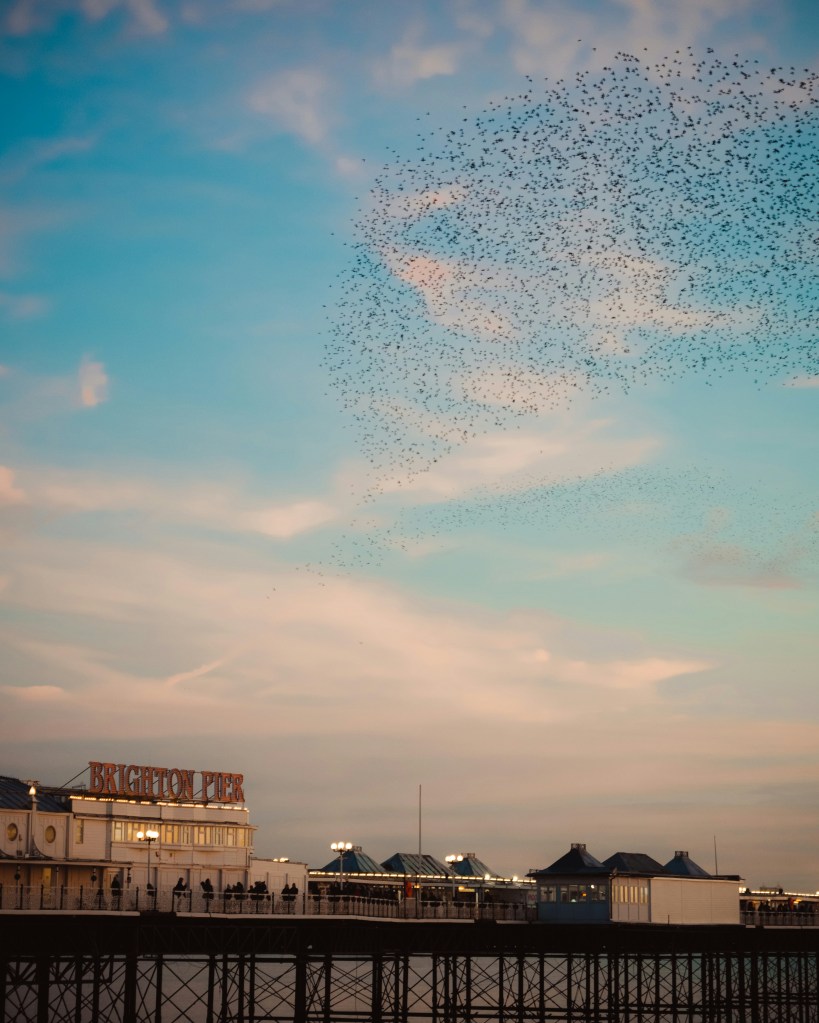
Murmurations act as an exemplar for the power and importance of practicing togetherness. Of organising, communicating, negotiating and acting together; fully responsible for ourselves, but so much stronger as a community.
This is an entry in the Anarchist Bestiary, an ongoing project which shares stories that enable us to learn with and from other species, with the aim of building a world together in which all can thrive.
The entry is available as a podcast above, about 7 minutes long or a text below.
Information
European Starlings live in the UK throughout the year, but through the winter months their numbers are doubled by migrants from Scandinavia to around 16 million birds. Throughout the winter they roost together in large groups and this is when these large groups will fly together, most commonly just before roosting for the night or first thing in the morning, in what are called murmurations.
Starlings are vulnerable to predation as they gather to roost and murmurations provide protection. They tend to be larger when raptors are flying in the area- raptors who might, ironically, be attracted by those very murmurations. Other theories as to the purpose of murmurations link them to environmental pressures and responses to stress, to shared exercise, and to them being an invitation, visible from a great distance, to roost together and share news and information about feeding grounds.
Over 500 hundred birds flying together is considered a murmuration, but anything from 15 to 50 thousand is more common and the largest recorded in the UK estimated at 6 million birds in 1999. The name itself comes from the sound of so many wings and the soft calls of the birds in flight.
The incredible dances rely simply on each bird co-ordinating by sight with its 7 immediate neighbours. In this way the mass of birds can change direction, tighten the distance between birds when there is a risk of attack by a raptor and coordinate take off and landing. Any movement by any bird is swiftly propagated through the flock from neighbour to neighbour. There is also evidence that the birds attend to the opacity of the whole murmuration to balance the need for close spacing to deter predation and the need for all birds to see their surroundings and each other clearly. Changing their wing orientations can cause flashes of light and dark to propagate through the murmuration- commonly called the sequin effect- and this can pass information around the flock even quicker than can their attention to each other.
Insurrection
In her 2025 paper titled- The Beauty of Anarchy: Murmurations as a Collective Response to Uncertainty, Katya Kyrlova argues for murmurations as examples of Kropotkin’s contention that mutual aid is a driver of evolution. Starlings come together in mutual aid, to ensure the survival of all, and the organisation of a murmuration, she further argues, follows anarchist organisational principles.
Murmurations are synchronised between all participants, spontaneously and in the absence of a set agenda or hierarchy. Murmurations rely on, and hone, the skills of horizontal communication making the collective far stronger against predation than a single bird alone could be. When a raptor threatens the flock, the density of the murmuration at the threatened point will increase with birds coming closer together to make it harder for the bird of prey to catch one individual- a literal example of solidarity The murmuration is only successful if the participants are sufficiently numerous and everyone plays a fair and equal role. Synchronised action by sufficient participants, organised horizontally and fairly between all, argues Kyrlova, constitutes an exemplar for social organising without a distinct leader. She writes: The flock of starlings, seen as a community of care, exemplifies this kind of social competency manifesting in the learned and regularly practised ability of each individual to focus entirely on others and act accordingly. (p. 36).
Murmurations fly for around 30-45 minutes at a time, like a regular workout, and in a beautiful phrase she calls murmurations a training in togetherness and commends the example to humans as a way to inculcate and literally practice community and togetherness.
She emphasises that her intention here is for us to see starlings as mentors in practicing mutual aid and solidarity in immediate, physical ways. This willingness to learn from another species is itself radical and institutes a cross-species togetherness that is part of dissolving the separation between humans and nature.
What can we learn from murmurations? We can see the communication and cooperation within the murmuration to be an encouragement for organising and building community. A reminder to practice togetherness- to come together often to walk and talk, dance, share food and work together, to join forces against the oppression of concentrated power. To find that our greatest strength is the conversation around the kitchen table, the gathering together and talking and sharing that becomes a praxis directed towards mutual thriving.
Inspiration
Directly quoted in the entry:
Krylova, K. (2025). The Beauty of Anarchy: Murmurations as a Collective Response to Uncertainty. Anarchist Studies, 33(2), 50–81. https://doi.org/10.3898/AS.33.2.02
This book references murmurations using also the phrase “a conference of birds” and the book inspired my final paragraph about conversation around the kitchen table: Harney, S., & Moten, F. (2021). All incomplete. Minor Compositions.
Text of the Conference of the Birds poem which is itself a parable of self-organisation:
The conference of the birds, Mantiq Ut-tair; a philosophical religious poem in prose
Photo by Rhys Kentish on Unsplash


