
Becoming Ungovernable
Jellyfish can inspire us to escape authority, making ourselves invisible, undefinable and ungovernable; to read the prevailing currents and, avoiding co-option occupying the margins, to thrive outside the mainstream.
This is an entry in the Anarchist Bestiary, an ongoing project which shares stories that enable us to learn with and from other species, with the aim of building a world together in which all can thrive.
The entry is available as a podcast above, about 8 minutes long or a text below.
Information
“Jellyfish” is not a scientific term. Instead, it is a common name for a large number of different gelatinous, marine, planktonic animals including salps and comb jellies as well as the Medusazoa which are the jellyfish of our imagination and to which I will refer.
The classic jellyfish has an umbrella shaped bell which pulses to provide propulsion and tentacles dangling below it that sting and capture prey- this is the body shape to which the term medusa refers.. This medusa characterises the adult phase of the jellyfish, whose complicated lifecycle commonly also has a larval stage and a period attached to the sea floor. The medusa usually represents the end of their life, although some species are able to revert to the larval stage and begin the cycle anew, effectively a kind of immortality.
Jellyfish are radially symmetrical with a body plan arranged around a central axis, like spokes on a bicycle wheel. They process sensory information from organs that can sense light, gravitation, water movement, chemicals in the water and their own body position but they do not have one central brain, rather networks of nerves distributed through their bodies. They can sustain damage that can be quite extensive without compromising survival and can regenerate lost tissue, reorganise their bodies to regain their symmetrical shape or even recombine with damaged parts of themselves.
Jellyfish are mainly carnivores feeding on other plankton, fish, and crustaceans caught by their trawling tentacles. Contracting and expanding their bell provides propulsion but they cannot move as fast as many sea currents, so their control over where to travel is only partial, hence being called planktonic which comes from the Greek for “drifter” or “wanderer” and refers to creatures that drift with the currents.
Jellyfish can navigate sufficiently, riding ocean currents, to form large aggregations where conditions favour them. Some species can survive in oxygen poor environments quite well and hotter conditions and nutrient-rich seas, sometimes brought on by agricultural and urban run-off, are causing these to become more prevalent, which those species can benefit from. Fish and other zooplankton cannot survive in these dead-zones or marginal environments whereas some jellyfish can and in the presence of nutrients and absence of predators huge blooms sometimes develop.
Insurrection
In 2009, James C. Scott published The Art of Not Being Governed: An Anarchist History of Upland Southeast Asia about the hilly areas of mainland Southeast Asia that have historically been beyond the control of governments based in the population centers of the lowlands. The thesis of the book is that traditional history is written from the point of view of the state describing what amounts to the internal colonisation of a territory as if the transition to statehood was inevitable. Scott presents an alternative to that inevitable story explaining how some peoples resisted attempts to co-opt them into a state and found ways to continue their lives free of coercion and state control .
He applies the term jellyfish to describe how various tribes evaded state control until fairly recently. Jellyfish tribes would make themselves unreachable and ungovernable in various ways. The metaphor draws on some characteristics of jellyfish: they can survive in inhospitable environments, they are difficult to see, they are resilient to harm having no central brain that can be destroyed, they can reform, reorganise and regenerate themselves and even move between life stages to survive.
Scott makes the metaphorical connections between jellyfish and the upland tribes, who would move high into inaccessible and inhospitable hill areas which were physically difficult to reach and survive in and prohibitively expensive for the state to occupy and police. There, tribes would practice agriculture involving crops that were hard for the state to appropriate for taxation.
Jellyfish tribes can break apart into smaller units and reform again elsewhere as needed. States want to tax and negotiate with clear tribal and household leaders, whereas these tribes would adopt social structures that had no fixed leadership. If the authorities caught up with a tribal group to register them, the tribe would dissolve before the authorities could return, splitting up and reforming elsewhere, their willingness to leave everything behind frustrating state apparatus. Many of the tribes returned to oral cultures refusing to read or maintain written records making themselves illegible to state bureaucracy.
Scott recognised that as states have become more powerful and developed more advanced technologies of control the jellyfish tribes have largely come under state capture. However, the term has been and can continue to be an inspiration for ways to avoid control by authority.
Fluid identities, the absence of a set leader or hierarchy, a willingness to move, reform and adapt to new places and lifestyles are all strategies through which affinity groups and communities can be united by principles and interests without succumbing to external authority. Jellyfish blooms can be an inspiration for the willingness to occupy places abandoned by authority, the temporary autonomous zones of squats and occupations for example. The lifeways of jellyfish offer inspiration for one way to subvert authority by becoming illegible, unfindable and ungovernable.
Inspiration
The original book quoted above: Scott, J. C. (2009). The art of not being governed: An anarchist history of upland Southeast Asia. Yale University press.
One example of a modern activist taking inspiration from the concept:
https://paulkingsnorth.substack.com/p/the-jellyfish-tribe
The original source of the term as quoted by a British historian describing the tactics of Pashtun tribes resisting co-option by the British.
Yapp, M. E. (1983). “Tribes and States in the Khyber, 1838–1842.” In Richard Tapper (Ed.), The Conflict of Tribe and State in Iran and Afghanistan. London: Croom Helm.
Thanks to John Terrenzi for his expertise on jellyfish- all the mistakes are mine but I know an awful lot more after his comments and support.
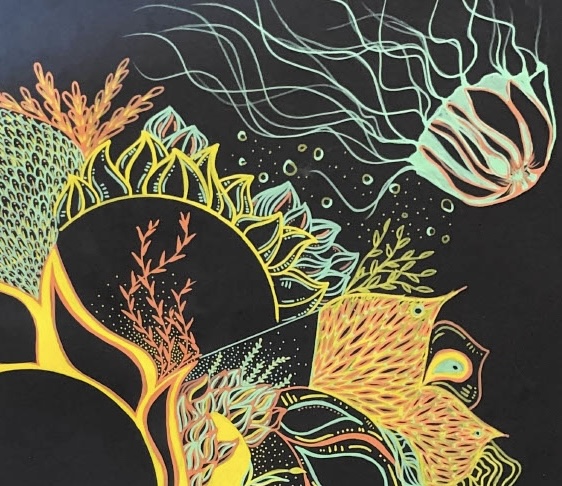
Art work by Zannia Kidd


