
This podcast features Efe Cengiz, a PhD student from Turkey who is doing his doctoral research at the University of Groningen. His doctoral research is focused on olive cultivation, agriculture in the face of climate change and environmental challenges, and giving a voice to the human as well as more-than-human actors in a local context. Efe shares his fascinating views on how different types of knowledge are produced in local contexts, and how we can listen more carefully to what they have to say. The podcast is 38 mins long.

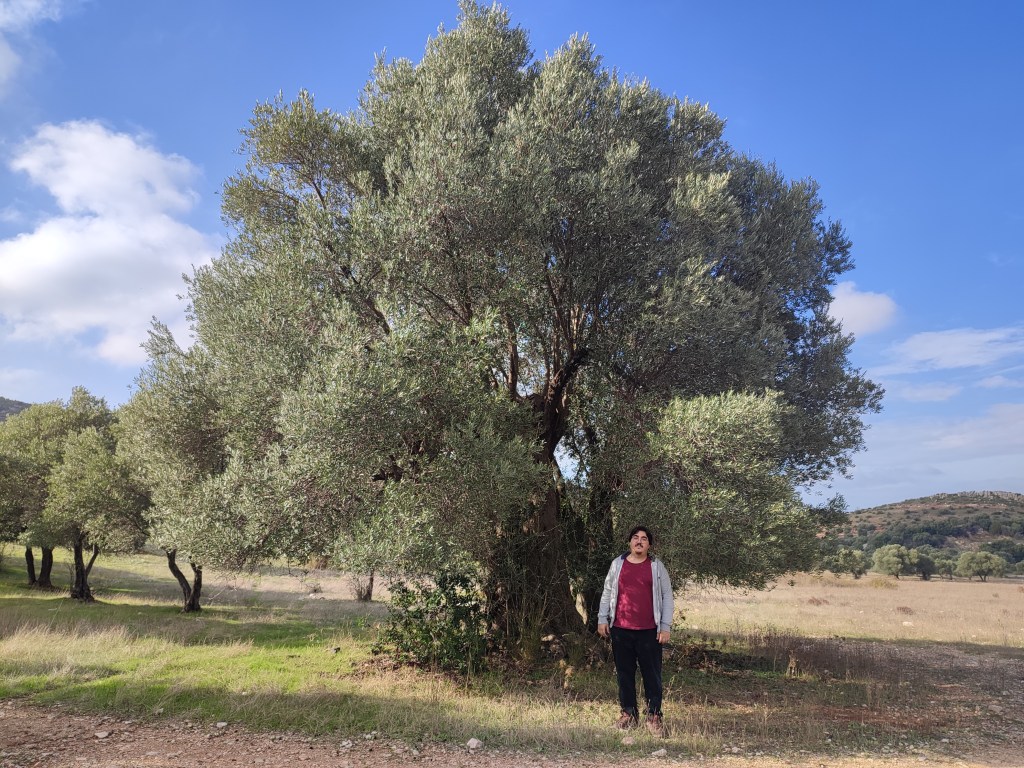
Efe’s descriptions of the images above
The first photo is posed in front of a huge tree that is around 500 years old, in a well managed orchard in the peninsula. It’s a photo I like using at olive conferences because it surprises the other researchers with how “improperly” tall it is; unfit for proper production. I like discussing how it was planted around the same age as Thomas Moore was publishing his Utopia; and although most utopic endeavours now are seemingly “dead” we can happen upon a tree in a field that is not just alive but also quite young thanks to the relations which foster its vitality.
The second photo depicts an olive tree that is around 3500 years old; it has spread in such a fashion that it looks as if it is several trees. I like that it is not fenced off for “protection” or “conservation”. It is still an active participant in the daily life on the farm it lives on. This farm has recently been converted into an highly experimental palliative care facility that uses cohabitation with bees to ease and manage patients’ pain. The interesting aspect is that this tree can come into new forms of relations as part of this care facility for example and affect its human cohabitants while still sustaining itself as a productive force and an important actor in local multispecies life. It makes me curious to think about how many human endeavours this tree bore witness to, affected and were effected by, and still keeps on being an olive tree. That is resilience in my opinion, far more than that which can be created in a lab.
Photos by Efe Cengiz, 2023/2024, Karaburun Pensinsula, Turkey
The recommendations shared by Efe
1. Akbelen forest Defense: An Environmental Justice Struggle by İkizköy Environmental Committee
https://ikizkoydireniyor.net/wp-content/uploads/2023/10/AKBELEN-FOREST_INFO_NOTE_OCTOBER-2023_s.pdf
Peasants, villagers and environmentalists gave and are giving a great fight to disallow the Akbelen forest, a forest full of olive trees, in Muğla/Turkey, 200 kms away from Karaburun, from being turned into a mining site. The Resistence of Akbelen, and this document produced by those who resist, are good opportunities to unlearn top-down and chauvinistic forms of activism and start learning how resistance practices, successful ones even, can be developed with the people and not just for the people.
2. Short interview with Özer Akdemir, the author of “If the Windy Mimas Doesn’t Awaken”
https://www.birgun.net/makale/ozer-akdemir-mimas-yeniden-ayaga-kalkacak-492624Özer Akdemir is a journalist and storyteller working on environmental justice struggles in Turkey. His book, “Rüzgarlı Mimas Uyanmazsa” is a work of lite-fiction, Akdemir dreams up emotional encounters with local human and non-human actors where ongoing environmental troubles in the Karburun region become easy to see and understand. The book is only available in Turkish but this interview he gave about the book can be easily accessed and translated.
Additional resources.
Here is the poem Efe quoted in the podcast if you want to translate it and read!
Here is a collection of videos and stills from Efe showing the region he works in.

 Punk Ethnography